CS2 Sound Information: Report the Cue Without Inventing the Position
A footstep or utility sound can be useful without revealing an exact location. Separate the cue from the inference, keep its timing clear and use the map geometry to decide what it supports.
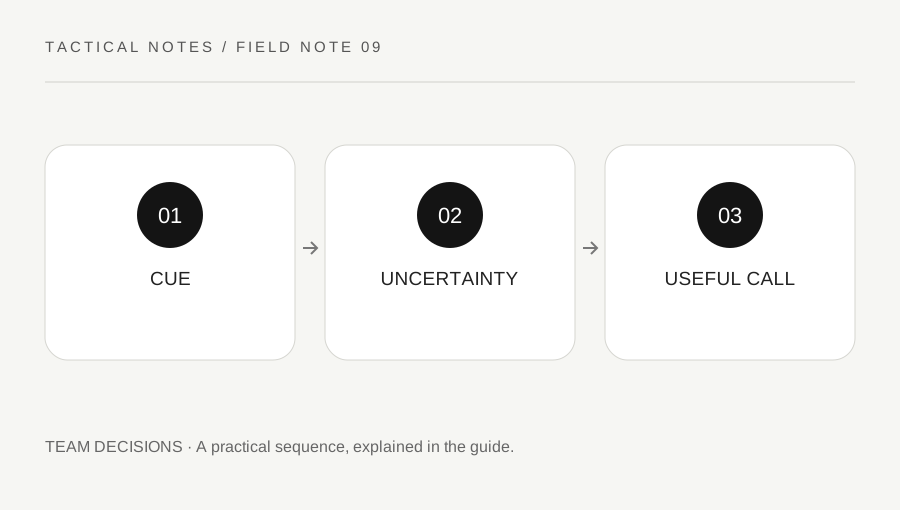
Original explanatory diagram. Examples illustrate a method or decision; they are not claims of personal testing.
Describe what was heard
Begin with the sound and approximate direction rather than a complete claim about the opponent. A cue can suggest movement, an action or utility while leaving floor, distance and current position uncertain. State those limits in the call.
Use comfortable volume and reduce unrelated media that masks the game. Louder playback does not replace careful interpretation. Do not assume every device or room presents the cue identically, and use supported settings rather than an unverified audio modification.
This guide develops information discipline, not a permanent hearing-distance table. Game audio and map geometry can change through updates. The useful habit is reporting evidence accurately enough that teammates can combine it with their own view without treating your uncertain impression as a confirmed player position.
Compare the cue with the route geometry
Identify the possible connecting paths, walls and height changes near the heard direction. A sound behind a surface may have more than one plausible source. Do not rush into an unknown angle solely to force confirmation.
Check what teammates already know. Another player's direct view can support or contradict the inference. Keep both observations clear rather than replacing the stronger evidence with the more confident voice.
For a worked example, a player hears activity toward a connector but cannot tell which side of a nearby junction it came from. They call the broad area and uncertainty. A teammate holds the relevant exit while the team gathers another view, instead of rotating every defender based on an exact location that was never established.
Keep your own sound choices purposeful
Read the current controls for walking, movement and interaction in a supported practice environment. A quiet approach can trade speed for reduced information given away, while an urgent objective may require faster movement. Avoid a rule that one movement mode is correct at every moment.
If you make an audible action, consider what the opponent may learn and what the team gains. A deliberate distraction is different from accidental noise caused by a misunderstood binding. The review should distinguish intention from execution.
Do not assume a familiar action is silent without checking current behavior. Use ordinary supported practice and the actual map. A remembered trick from an older game version should not become a guaranteed information advantage in a current guide.
Review the inference after the round
Write the cue, your call and what later evidence confirmed. If the interpretation was wrong, identify the missing distinction rather than concluding that every sound is useless. If the call was accurate but the team overreacted, review how uncertainty was communicated.
Keep hindsight separate. A demo can reveal an opponent's exact path that you could not see during play. Use it to understand the cue, not to pretend the original decision had perfect information.
Finish with a concise call pattern: cue, area, time and uncertainty. That structure produces information teammates can use while preserving its limits. Sound becomes part of a shared map picture, not a magical locator or a reason to abandon every established position whenever one ambiguous action is heard.
When several cues overlap, report that limitation explicitly. A shorter uncertain call can be more accurate than selecting one exact route merely to sound decisive.
A practical checklist
Choices are saved in this browser. Reset them here or clear this site’s browser storage.
Questions that come up
Does a sound reveal an exact opponent position?
Not always. Geometry, direction and timing can leave several possibilities. Keep the uncertainty in the call.
Should I always walk quietly?
No. The objective and timing can require another movement choice. Make the tradeoff deliberate.
Can a demo prove I should have known everything?
No. Separate information shown later from evidence available during the round.
References & scope
Background references checked on 18 October 2026. Worked examples and diagrams are original teaching material.