CS2 Utility Teamwork: Use Smoke, Flash and Fire for a Clear Team Action
A useful grenade changes what your team can do next. A smoke without a crossing, a flash without a ready teammate or fire placed in your own route may consume money without creating an advantage. This guide offers original utility decision examples for CS2, with official sources reviewed on October 18, 2026. Valve documents dynamic smoke as a CS2 feature. Exact lineups, map geometry and grenade behaviour can change, so practise the current build rather than copying historical coordinates.
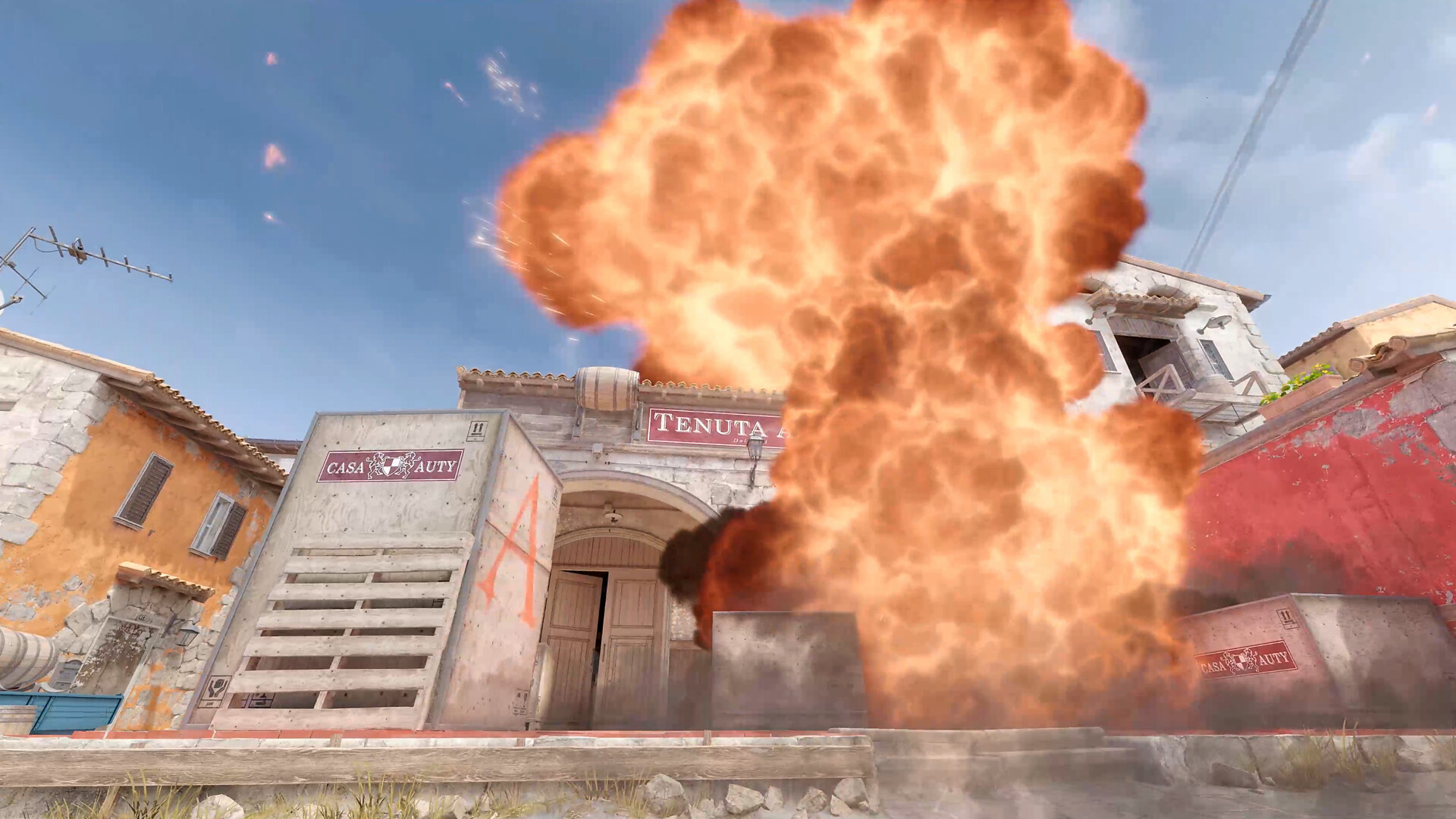
Official game screenshot · Valve. Publisher-provided public store media used to illustrate independent editorial discussion. Copyright remains with the respective rights holders; no redistribution license is offered.
Name the angle or action the utility should change
Before selecting a grenade, identify the immediate problem. You may need to cross a watched lane, reduce the number of defenders visible on entry, delay a push or interrupt a comfortable holding position. State the intended action in a short phrase, such as smoke the crossing, then move together. This makes it possible for teammates to prepare. If no one intends to use the opening, the grenade may be premature. Avoid throwing everything simply because a round has begun. Retained utility can matter later, provided you do not become so cautious that you die with every useful tool unused.
Use smoke to reshape sightlines, not declare safety
A smoke can interrupt a viewing angle, but it does not prove the area behind it is empty or stop every threat from another direction. Consider which side of the smoke your team will occupy and whether its edge creates an awkward close fight. Valve's CS2 materials describe dynamic smoke, so historical assumptions about a static visual wall should not be treated as complete. Confirm the actual result in current practice. After the throw lands, move with purpose while watching the remaining angles. Do not stand together admiring the smoke while the movement window disappears or an enemy flanks around it.
Time a flash for the teammate who will act
Tell a teammate what you intend to flash and wait until they can use it. Their position, viewing direction and entry timing matter as much as the throw. Avoid blinding teammates who are already committed to a duel without warning. In practice, check both the likely defender view and your teammate's route. A flash that appears impressive from the thrower's position may be easily avoided or may affect the wrong players. Keep the instruction simple: identify the angle and the moment to move. If the team is not ready, hold the grenade rather than turning an uncoordinated throw into an equally uncoordinated rush.
Use fire and explosive damage to support movement
An incendiary-style area effect can pressure a position or delay a route, but placement must fit where your own team needs to go. Do not block the path to the bomb or force a teammate out of their only cover. Explosive utility is most useful when there is a reason to expect an opponent in the affected area, rather than a guess repeated every round. Consider the follow-up: if an enemy leaves the position, who watches the escape? If the grenade merely moves them into an unwatched angle, the problem may remain. Read current item behaviour and side-specific availability in the buy menu.
Learn one practical throw before collecting many lineups
Pick a common problem on a map you play and practise a simple reliable throw that solves it. Record the current map, starting position, aim reference and ordinary input sequence in your own notes. Test the actual landing and resulting coverage several times in the current build, then practise moving immediately afterward. Do not publish or trust an exact lineup merely because it worked in an older map version. A small set you can perform under normal pressure is better than dozens of remembered screenshots. Use only supported in-game practice tools; no external automation is needed to learn useful utility.
Coordinate a small execute rather than a grenade show
Imagine your team must enter a site with a long watched lane and one close holding position. Assign a smoke to reduce the long angle, a flash to help the first pair enter and a player to watch the close escape. Check that the bomb carrier is not left behind performing every throw. When utility lands, move in tradeable spacing and clear the remaining positions. If the smoke misses, call that immediately and adjust rather than pretending the original plan remains safe. The plan's success is measured by the usable space and objective opportunity it creates, not the number of grenades thrown.
Review unused, mistimed and harmful utility separately
After a round, distinguish three mistakes. Unused utility may indicate an overly late decision or an unclear role. Mistimed utility may have landed before teammates were ready. Harmful utility may have blinded allies or blocked the needed route. Each requires a different correction. Keep one simple practice target for the next session, such as announcing the flash before throwing or checking the smoke's actual coverage. Avoid blaming a missed lineup for every lost round when the team never agreed on the action after it. Clear intent, current practice and coordinated movement make utility repeatable without an enormous playbook.
Your working checklist
Checkmarks stay in this browser when storage is available. They do not alter your game or connect to your account.
Put it into practice
- Name the watched angle or movement the grenade should enable.
- Confirm that teammates are ready and will not be blinded or blocked by the intended throw.
- Practise the current landing and coverage before relying on an exact lineup in a live round.
- Move or hold the assigned follow-up as soon as the useful window appears.
- Review whether utility was unused, mistimed or harmful and correct the specific failure.
Before you finish
- Every grenade has an action attached rather than being thrown from habit.
- Smoke reduces a sightline but is not treated as proof that the crossing is completely safe.
- Flash timing and viewing direction are communicated before a teammate commits.
- Map updates and current grenade behaviour have been checked before trusting a historical lineup.
Common questions
How many lineups should I learn first?
Learn a few that solve common problems on the map you actually play. Practise their current result and follow-up movement. A reliable basic crossing smoke or supportive flash is more useful than a long list you cannot reproduce under pressure.
Should everyone throw utility at the start of a push?
Only if the plan needs it and the timing works. Some players must be ready to enter, trade or carry the objective. Leaving every teammate behind with a grenade in hand can waste the opening the utility was meant to create.
Does smoke guarantee a safe plant?
No. Other angles, close opponents, flanks and current smoke interactions still matter. Clear the necessary space, protect the planter and understand which threats remain. Treat smoke as one part of the site plan, not a complete defence.