CS2 Map Guides: Turn Annotations Into a Route You Understand
A guide can show an intended route or position without explaining every decision. Use the current supported guide feature as a learning aid, then test whether you can navigate and communicate the route independently.
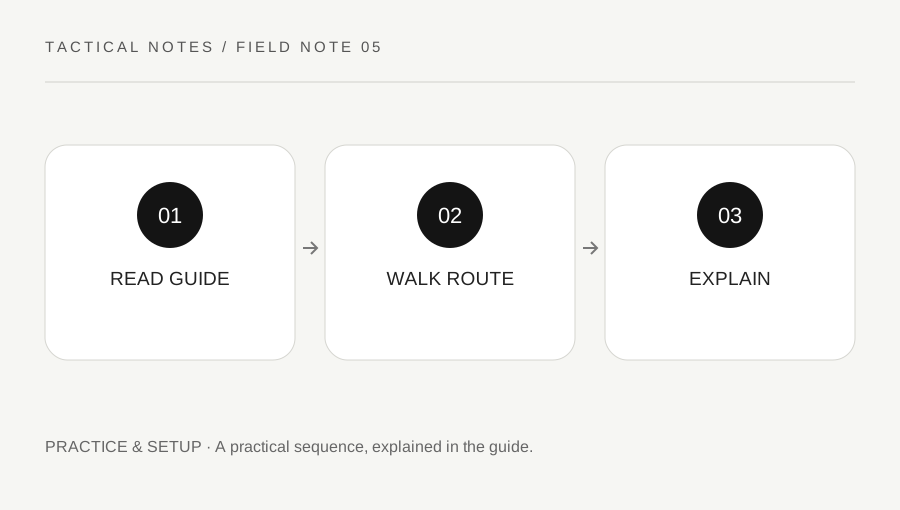
Original explanatory diagram. Examples illustrate a method or decision; they are not claims of personal testing.
Check the feature and mode rules
Valve's March 2026 update introduced map-guide tools and official starter guides, with later updates refining where and how they appear. Read the current game and official notes for availability rather than assuming an old practice setting is permitted identically in every mode.
Do not import an unknown configuration merely because it is labeled a guide. Use supported content and understand what is being loaded. Keep the map version and intended mode visible, especially when geometry or the active pool has changed.
This article complements the site's callout guide. Callouts help name places; annotations can help connect a route or task. Neither should replace understanding the actual view, cover and objective. A mark on the map is a prompt to inspect, not proof that the marked action is correct in every round.
Walk one route without pressure
Choose a short route and pause at each important annotation. Identify the visible angle, the next cover and the route back. Compare the guide's intention with what the current map actually allows.
Say the location names aloud or write a short route description. If the guide uses an unfamiliar label, resolve it before adding opponents or speed. A player who follows markers without understanding the names may still struggle to give useful information during a match.
For a worked example, a learner follows a starter route to a key area, then notices that one turn exposes an additional angle. They add that observation to their own note. The guide supplied a starting structure, while the walk created a more complete understanding of the route's limitations.
Test the task without the prompt
Hide or stop relying on the annotations where supported and repeat the route. Identify the next step from the map rather than waiting for a marker. This checks whether the guide supported learning or became the only way to navigate.
Then add one small question, such as which position can support a teammate's entry or where a utility effect would need follow-up. Keep it within the current map and normal rules. Do not treat a demonstration as a permanent lineup when geometry or physics updates can change it.
If the route becomes uncertain, return to the specific junction and inspect it again. Repeating the entire map aimlessly is less useful than repairing the point where the relationship between two areas remains unclear.
Carry a bounded lesson into a match
Choose one normal-match situation where the route knowledge applies. Opponents, utility, spawn and objective time can make the demonstrated path unsuitable, so retain the option to adapt. A guide is not an order to execute the same route regardless of information.
Review whether the route helped you communicate or find cover, not only whether the round was won. A correct navigation lesson can be present in a lost round, and a win can hide a route followed without understanding.
Finish with the map version, route and one explanation you can give without the prompt. Revisit after map updates. The useful result is transferable local knowledge: where the route goes, what it exposes and when it supports a team action. The annotation is a tool for building that knowledge rather than a replacement for the decision.
A practical checklist
Choices are saved in this browser. Reset them here or clear this site’s browser storage.
Questions that come up
Can a guide be assumed available in every mode?
No. Use the current game and official update notes for the permitted feature behavior.
Does an annotation guarantee a good play?
No. Opponents, timing and objective state can change what is useful.
Should old guide routes be checked after map updates?
Yes. Geometry and supported behavior can change, so inspect the current route.
References & scope
Background references checked on 18 October 2026. Worked examples and diagrams are original teaching material.