CS2 Early-Round Information: Learn Something Without Giving Away the Round
An early action should answer a useful question or support a route. Distinguish confirmed contact from an empty view, and keep the team’s next decision connected to the information actually gained.
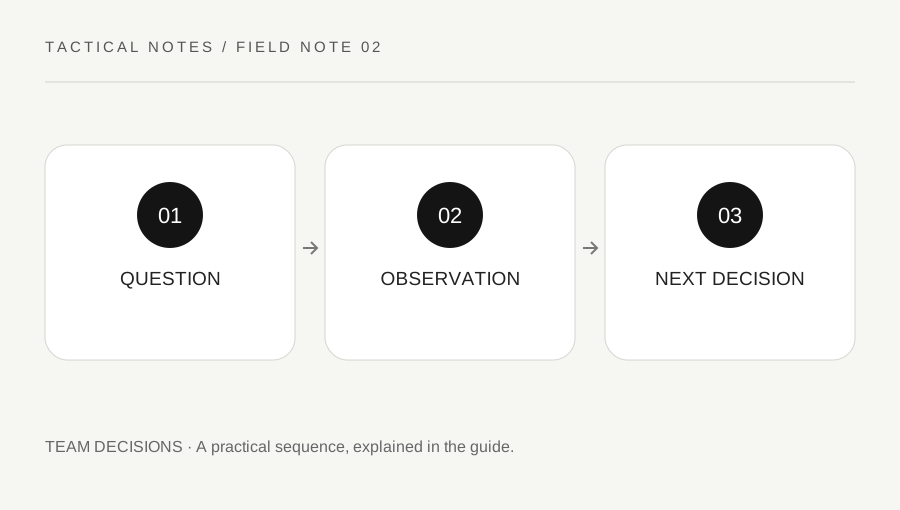
Original explanatory diagram. Examples illustrate a method or decision; they are not claims of personal testing.
Choose the question before the action
Ask what the team needs to know: whether an approach is contested, whether utility changes a route or whether a teammate can reach a useful position. An early movement without a question can expose a player while producing little information the team can use.
Keep the round plan and equipment in view. A low-resource round and a well-equipped round may support different information costs. This guide does not replace the buy-round article; it asks what the chosen early action is meant to establish.
Use the current map and mode. A route changed by an update or a custom server can invalidate a remembered timing. Avoid promising that an old starting path always arrives first. Treat the actual spawn, movement and visible conditions as part of the decision.
Record what the view does and does not establish
Seeing an opponent confirms a contact at a place and time. Seeing nobody in a narrow angle does not prove the entire site or route is empty. State the observed area precisely so teammates do not plan around an exaggerated all-clear call.
Utility can be evidence of activity without revealing every player. Keep the source and timing clear rather than converting one grenade into a precise count. A sound behind a wall also leaves uncertainties about route and current position.
For a worked example, a player checks one opening and sees no target. They report that specific angle as not contacted, while another unseen route remains unknown. The team uses the information to choose the next check rather than treating it as permission for every player to sprint into the site.
Keep a response and return route
An information action should leave a practical next step when possible. Identify the cover or support available if contact occurs. Do not stand exposed waiting for the perfect confirmation after the question has already been answered.
Coordinate with the teammate who benefits from the information. A peek that draws attention can support another action only if the timing is understood. Otherwise the first player pays the exposure cost while the team remains unready to use it.
If the original route is blocked, update the plan rather than repeating the same action out of habit. A second identical peek can have a different risk because the opponent now expects it. The useful decision depends on the changed information, not on proving that the first route must work.
Review information quality rather than activity volume
After the round, write the question, the observation and the decision it supported. If the team could not use the information, identify why: too vague, too late, no supporting position or an assumption presented as certainty.
Review successful rounds too. A risky early action can succeed without producing reliable information, and a cautious correct observation can still be followed by a later error. Outcome alone does not show whether the information step was sound.
Finish by choosing one specific next-round habit, such as naming the observed angle or leaving after the first clear contact. This makes early-round play purposeful. The goal is useful, bounded evidence that improves a team decision, not constant movement or a long stream of calls that sounds busy while leaving the actual map state unclear.
A practical checklist
Choices are saved in this browser. Reset them here or clear this site’s browser storage.
Questions that come up
Does seeing nobody mean a site is empty?
No. It only describes the checked view at that moment. Other positions and routes can remain unknown.
Does one utility sound reveal an exact player count?
Not reliably. Keep the evidence and its limits clear.
Should I repeat the same peek until I see someone?
Reassess the changed risk and purpose. Repetition is not automatically useful information gathering.
References & scope
Background references checked on 18 October 2026. Worked examples and diagrams are original teaching material.